Skip to content
Back to blog
MarketingFeb 10, 2026

Building a Strong LinkedIn Presence: Strategies for B2B Success

Building a Strong LinkedIn Presence: Strategies for B2B Success

LinkedIn has evolved from a job search platform into the most powerful B2B social network in the world. With over 900 million members, it's where business decisions are influenced, partnerships are formed, and thought leaders build authority. Yet most B2B brands and professionals barely scratch the surface of what's possible on the platform.

This guide covers everything from profile optimization to content strategy to lead generation — a complete playbook for building a LinkedIn presence that drives real business results.

Why LinkedIn Matters for B2B

LinkedIn isn't just another social platform — it has unique characteristics that make it essential for B2B:

  • Decision-maker access: 4 out of 5 LinkedIn members drive business decisions
  • High-intent audience: People come to LinkedIn to learn, network, and discover solutions
  • Organic reach: LinkedIn's algorithm still favors organic content more than most platforms
  • Trust factor: Content on LinkedIn carries more professional credibility than on casual platforms
  • Long content lifespan: A good LinkedIn post can generate engagement for 24-72 hours, compared to minutes on X or Threads

If your customers are other businesses, LinkedIn should be a cornerstone of your social strategy — not an afterthought.

Profile Optimization

Before you post a single piece of content, make sure your profile is optimized. Your profile is your landing page — every post you write will drive some viewers back to it.

Your Headline

Don't just list your title. Communicate your value in 120 characters:

  • Weak: "Marketing Manager at Company X"
  • Strong: "Helping B2B SaaS companies 3x their pipeline through content"
  • Even stronger: "B2B Content Strategy | Helped 40+ SaaS companies grow pipeline | Founder @YourBrand"

Your headline appears everywhere — in search results, in the feed next to your posts, and in connection requests. Make it count.

Your About Section

Your About section should tell a story, not read like a resume. Structure it as:

  1. Hook — Open with a compelling statement or question
  2. Who you help — Your target audience
  3. What problems you solve — Be specific about outcomes
  4. Your unique approach — What makes you different
  5. Social proof — Brief mention of results or clients
  6. Call to action — What should the reader do next?

Keep it scannable with short paragraphs and line breaks. Most people skim.

Featured Section

Showcase your best work in the Featured section:

  • Top-performing posts — Your best LinkedIn content
  • Case studies — Results you've achieved for clients
  • Lead magnets — Guides, templates, or tools to capture emails
  • Media appearances — Podcasts, articles, or interviews
  • Your website or product — Drive traffic where it matters

Banner Image

Your banner is prime real estate. Use it to communicate:

  • What you do
  • Who you serve
  • A call to action (website, newsletter, product)

Don't leave it as the default blue gradient.

Content Strategy

Content Types That Work on LinkedIn

Not all content performs equally. Here's what consistently generates engagement:

  1. Personal stories — Lessons learned, failures, and wins. These humanize your brand and build trust. Posts starting with "I" tend to outperform those starting with "The" or "Here's."

  2. Industry insights — Your informed take on trends and news. Add your perspective — don't just share a link.

  3. How-to content — Tactical, actionable advice that people can implement immediately. Lists and step-by-step formats work well.

  4. Behind-the-scenes — Show your work process, your team, your decision-making. Authenticity builds connection.

  5. Engagement posts — Questions, polls, and discussion starters. These tend to get high comment counts, which signals the algorithm to boost reach.

  6. Data and original research — Share statistics, survey results, or benchmarks. Data-driven posts get saved and shared.

Content Formats

LinkedIn supports several formats — use variety to keep your feed interesting:

  • Text posts — Still the highest-performing format for most creators
  • Carousels (PDF documents) — Great for educational content and step-by-step guides
  • Images — Behind-the-scenes photos and infographics
  • Videos — Short (under 2 minutes) performs best
  • Newsletters — LinkedIn's built-in newsletter tool for long-form subscribers
  • Articles — Long-form posts that live on your profile permanently

Posting Frequency

Quality over quantity, but consistency matters:

  • Minimum: 2-3 posts per week
  • Optimal: 1 post per day (weekdays)
  • Maximum: Don't exceed 2 posts per day — the algorithm may suppress reach

The best approach is to schedule your content in advance so you maintain consistency even during busy weeks.

Engagement Strategy

Posting is only half the equation. Engagement — both on your own content and others' — is what builds your network and amplifies your reach.

The 5-3-2 Rule

For every 10 LinkedIn interactions:

  • 5 comments on others' posts (especially those in your target audience)
  • 3 shares of valuable content with your own commentary
  • 2 of your own posts

This ratio ensures you're building relationships, not just broadcasting.

Comment Quality Matters

Don't just say "Great post!" That adds zero value and won't get you noticed. Instead:

  • Share a related experience — "This reminds me of when we..."
  • Ask a thoughtful question — "How did you handle [specific challenge]?"
  • Offer a different perspective — "I'd add that..."
  • Provide additional context — "We saw similar results — specifically..."

Aim for comments that are 3-5 sentences. Thoughtful comments get likes and replies of their own, which exposes your profile to new audiences.

Timing Your Engagement

The first 60-90 minutes after posting are critical on LinkedIn. The algorithm evaluates early engagement to decide whether to show your post to a wider audience. Plan to:

  1. Post during peak hours (Tuesday-Thursday, 8-10 AM in your audience's timezone)
  2. Be available to reply to every comment within the first 2 hours
  3. Engage with other posts before and after your own goes live

Lead Generation on LinkedIn

Inbound Approach (Long-term, Sustainable)

Build a system where prospects come to you:

  • Create valuable content consistently — Solve problems your ideal customers have
  • Include soft CTAs — "DM me if you want to learn more" or "Comment 'guide' and I'll send it"
  • Optimize your profile for conversions — Make it crystal clear what you offer and how to take the next step
  • Build a newsletter audience — LinkedIn's newsletter feature captures subscribers directly

Outbound Approach (Faster, More Direct)

Complement inbound with strategic outreach:

  • Connect with ideal prospects — Personalize every connection request with a specific reason
  • Engage before pitching — Comment on their posts 3-5 times before reaching out
  • Personalize every message — Reference their content, company, or specific challenges
  • Provide value first — Share a relevant resource, insight, or introduction before asking for anything

The key is combining both approaches. Inbound builds credibility, outbound converts it into conversations.

Measuring LinkedIn Success

Track these key metrics monthly to evaluate your LinkedIn strategy:

  • Profile views — Are more people discovering you?
  • Connection requests received — Are the right people finding you?
  • Post impressions — Is your reach growing?
  • Engagement rate — Is your content resonating?
  • Inbound leads — Are you generating business?
  • Conversations started — Are connections turning into relationships?

Set monthly targets for each metric and review progress every 30 days. If a metric isn't improving, adjust your strategy.

Common LinkedIn Mistakes

  1. Selling too soon — Build relationships before pitching. Nobody responds to "Hi, want to buy my product?" as a first message.
  2. Inconsistent posting — The algorithm rewards consistency. Disappearing for two weeks kills your momentum.
  3. Ignoring comments — Engagement is a two-way street. Reply to every comment on your posts.
  4. Generic content — "5 tips for better marketing" has been posted a million times. Add your unique spin, data, or story.
  5. Only posting, never engaging — LinkedIn is a social network, not a publishing platform. Spend equal time commenting as posting.
  6. Neglecting your profile — Even great content won't convert if your profile doesn't clearly communicate who you are and what you offer.

Start Today

Pick one strategy from this guide and implement it this week. LinkedIn success is built one post, one comment, one connection at a time. You don't need to do everything — you need to do something consistently.

Start by optimizing your profile, then commit to posting 3 times per week for 30 days. Track your results, iterate, and build from there.

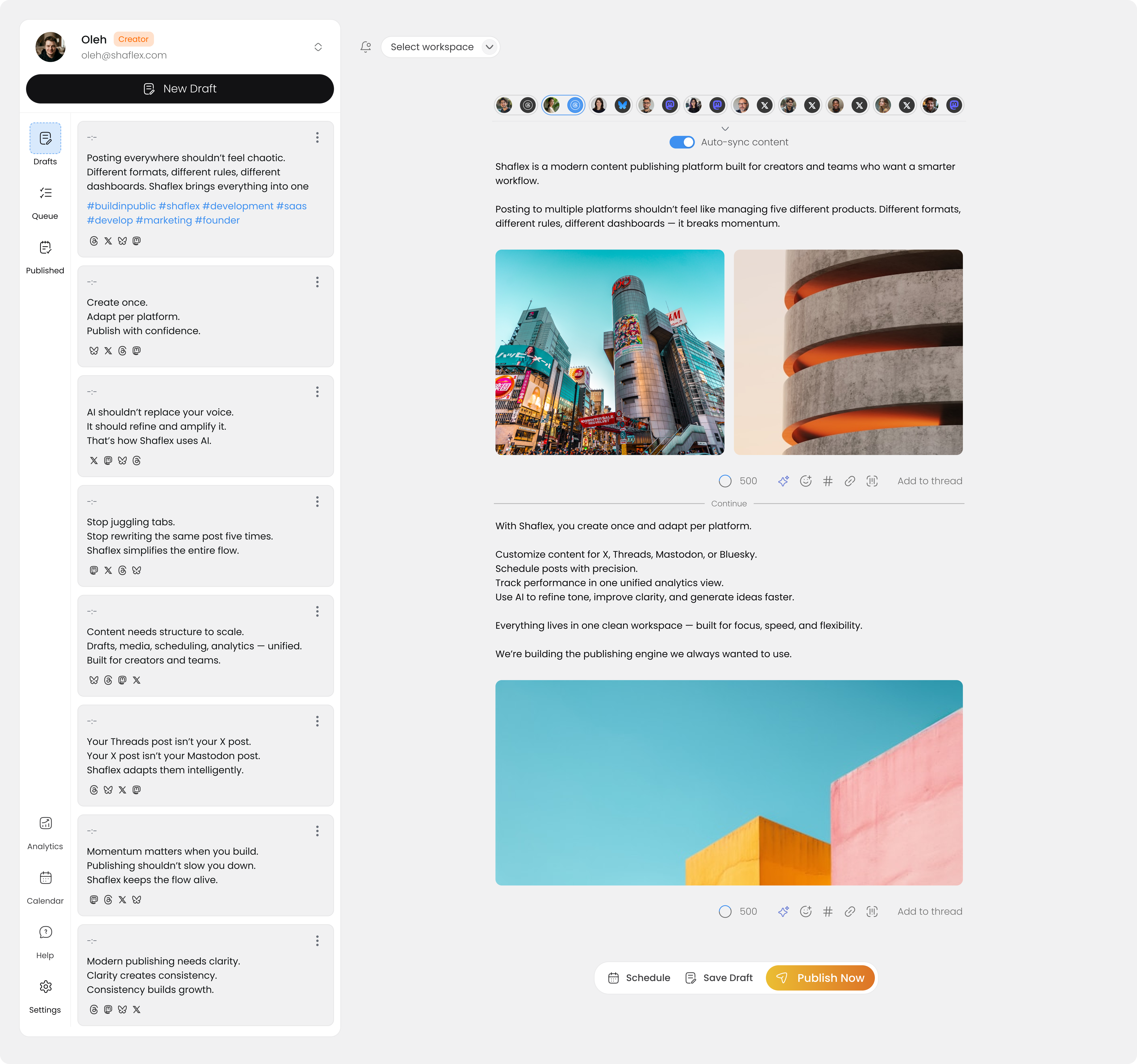
Want to streamline your LinkedIn posting alongside your other social platforms? Try Shaflex for free and publish to LinkedIn, X, Threads, and more from one place.

Social Media Analytics: The Only Metrics That Actually MatterFeb 25, 2026
Marketing

Social Media Analytics: The Only Metrics That Actually Matter

Cut through the noise and focus on the analytics that drive real business results for your social media strategy.

Read More
How to Use AI for Content Creation Without Losing Your VoiceFeb 18, 2026
Engineering

How to Use AI for Content Creation Without Losing Your Voice

Practical tips for leveraging AI tools to speed up content creation while maintaining your unique brand voice.

Read More
Mastering Social Media Scheduling: A Complete Guide for 2026Jan 15, 2026
Marketing

Mastering Social Media Scheduling: A Complete Guide for 2026

Learn how to effectively schedule your social media content to maximize engagement and reach your audience at the right time.


Read More

Publish Everywhere, Effortlessly

Join creators who save time with Shaflex.

Get Started
Shaflex app preview